
Reducing the drain of daily decision making
Are you feeling like you can’t make any more decisions? Do you feel utterly exhausted by the amount of thinking and decision making you need to do every single day?
Feeling like you can’t make any more decisions is common, especially for women who are juggling a home and all that it brings. Often before you have even begun work, you can have found that you have used up a lot of the energy that helps you think clearly. You can find yourself stuck on relatively minor, unimportant decisions meaning that when the important, bigger choices come along you have very little ability to make balanced decisions left.
What am I going to wear today? What are the kids going to wear?
What are we eating today? Do we need to get anything from the shops for the meal that I don’t what it is yet?
What present am I going to buy for the party my child is going to on Saturday?
Am I going to do that workout today?
Do I need to send the children with wellies and waterproofs and a sunhat today? Or just the wellies?
These are just a few of the daily decisions that can float around in your head from the moment that you wake up until you go to bed (they may also feel like they feature in your dreams if you are extra lucky!), without anyone else asking you anything else.
Then comes the bigger questions
Do we need to move house?
What school catchment do we want to be in?
Is this the right career for me? Should I change jobs?
Should I return to work or stay at home?
Should I try self-employment?
Where are we going on holiday this year?
All of these questions, without even considering any work based thinking that is required of you. The mental load that you carry on a daily basis can feel so burdensome that it can leave you feeling foggy and unable to think clearly.
Why does decision making leave me feeling so frazzled?
Your brain is like any other muscle, it gets tired after a workout. The area of your brain (pre-frontal cortex) that is used when considering different options and making a final decision, is the same part of the brain that is used for rational, considered thoughts; that enables you to inhibit socially unacceptable behaviours (or so that you can hold you tongue when yelling for the 100th time that morning for everyone to put their shoes and coats on); that exerts willpower. Unfortunately, the pre-frontal cortex uses up a lot of fuel to keep going. This is why your ability to think clearly diminishes as the day goes on and when you are hungry.
You are not a bottomless cylinder of energy that can keep on giving. You have limited energy, and as such will have limited energy to be used for thinking and decision making.
How can I reduce the decision making fatigue?
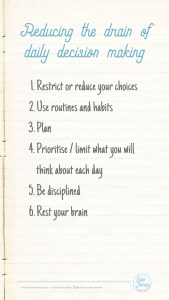
The short answer is make less decisions and be smarter about the ones you do make. But how do you make that work in terms of everyday life of a busy family? Here are some of my top tips to get you started:
Restrict or reduce the choices
Everyday you will be using your thinking energy up on relatively minor, unimportant decisions. If you think about all the things that you are contemplating when you wake up in the morning, there will be some things that you can restrict yourself on. Obama was reported to have said that he only wore gray or blue suits, so that he didn’t need to be distracted by decisions over what to wear. Is a capsule wardrobe one way that you can reduce your unneccessary thinking every day? My husband would defintiely benefit from this advice! What other things could you pre-determine or reduce the options in front of you? Can you create ‘master lists’ that carry forward every day or week, that reduce some of the thinking that you need to do. For example, standard shopping lists or household job lists (The Organised Mum Method is popular for this approach to keeping on top of the housework). That way you don’t need to decide what you need to get or do, look at the list and see what it says.
Use routines and habits
When you do something habitually you are using a different area of the brain (the basal ganglia) that uses a lot less energy than the part of the brain used for rational thought (pre-frontal cortex). When your thinking brain gets tired, it defaults to the habitual brain. This is why, you may find yourself ‘slipping into old habits’ when you are tired, stressed or overwhelmed. When something becomes habitual it frees up your ability to think, for the things that really need your attention (problem solving, thinking creatively, making considered decisions).
What things could you re-allocate to the habitual brain? What things happen over and over again, that do not require you to make new choices everytime?
Plan
Planning is one of those things that people tend to love or hate. I am going to confess, that although I love helping other people plan their time effectively, and I have created a practical planner for busy women, it is often the thing that I put off the most for myself, especially when I am busy. However, I know that this is a crucial step in reducing the mental load for me when managing a home, a family, a business, studying and my voluntary commitments. When you have a plan in place, it will reduce the decisions that you are making. I know that when I have planned what is for dinner that day, I feel a huge sense of relief! Rather than spending all day, considering all the different things I could possibly cook. If planning is something you struggle with, keep it simple and regular.
Prioritise / limit what you will think about each day
If you are feeling overwhelmed by the sheer volume of choices that are ahead of you, reduce the overwhelm and choose your focus. Rather than keeping all the things whizzing round in your head and not moving forward with anything, prioritise which things you are going to give your attention to that day. Limit yourself. You will come back to the other things when they need your attention. At this point have a notebook or an app that you keep them jotted down in. You can then come to them when it is the right time for them.
Be disciplined
To reduce the amount of time that you spend procrastinating over things, set some boundaries and stick to them. This may be that you put apply a time limit (set a deadline) or outline some clear criteria that needs to be met. Once that criteria has been met, move on to the next thing that needs your focus. The essential element of this step is to then stick to them, exert some will power. Yes, willpower takes up energy and brain resource however, this will in turn save you so many hours of going round and round in circles and getting nowhere.
Rest your brain
As mentioned, using the prefrontal cortex zaps your energy. If you are physcially tired, you are not going to be able to think as clearly. It is also suggested that throughout the day, your brain effectively gets gunked up and this hinders it’s ability to process anything effectively. A short nap, enables your brain to degunk (effectively defrag itself). Sleep can be a challenge to any parent out there who is struggling with sleepless nights. So, how can you resolve this one? Firstly, being aware of when you are making decisions – don’t start trying to do it at the end of the day, when all you can think about is putting your head on the pillow or when you are hungry. Secondly, there are other steps you can take to provide your brain with some relief from constantly being bombarded with information and demands:
- mindfulness or other forms of meditation
- exercise
- going outside
- dancing
Finally, don’t forget that when you are hungry, your brain won’t have the energy to work effectively. Nourishing yourself with rest and food, will help you feel more effective.
As with everything, be curious, try the different strategies and adapt them to work for you. Remember, change takes time to implement and to see the benefits. Don’t try and adopt all of these immediately because that in itself will feel overwhelming. Gradually review your current routines and habits, and build on them.
If you are feeling overwhelmed with managing the mental load and juggling life, get in touch to book a coaching session with me, to help you get back some clarity and focus.

